Fixed income: Strong returns realised, the anchor holds
Fixed income remained the bedrock of the portfolio, delivering a strong stable return as the tilt towards Uganda's higher-yielding market continued to anchor performance. Relatively higher yields, secured from years of patient value investing and reinforced by reinvestment at still-attractive rates, supported the portfolio through a year of regional rate easing and currency movements.
Portfolio value
Interest income
Twelve-month return
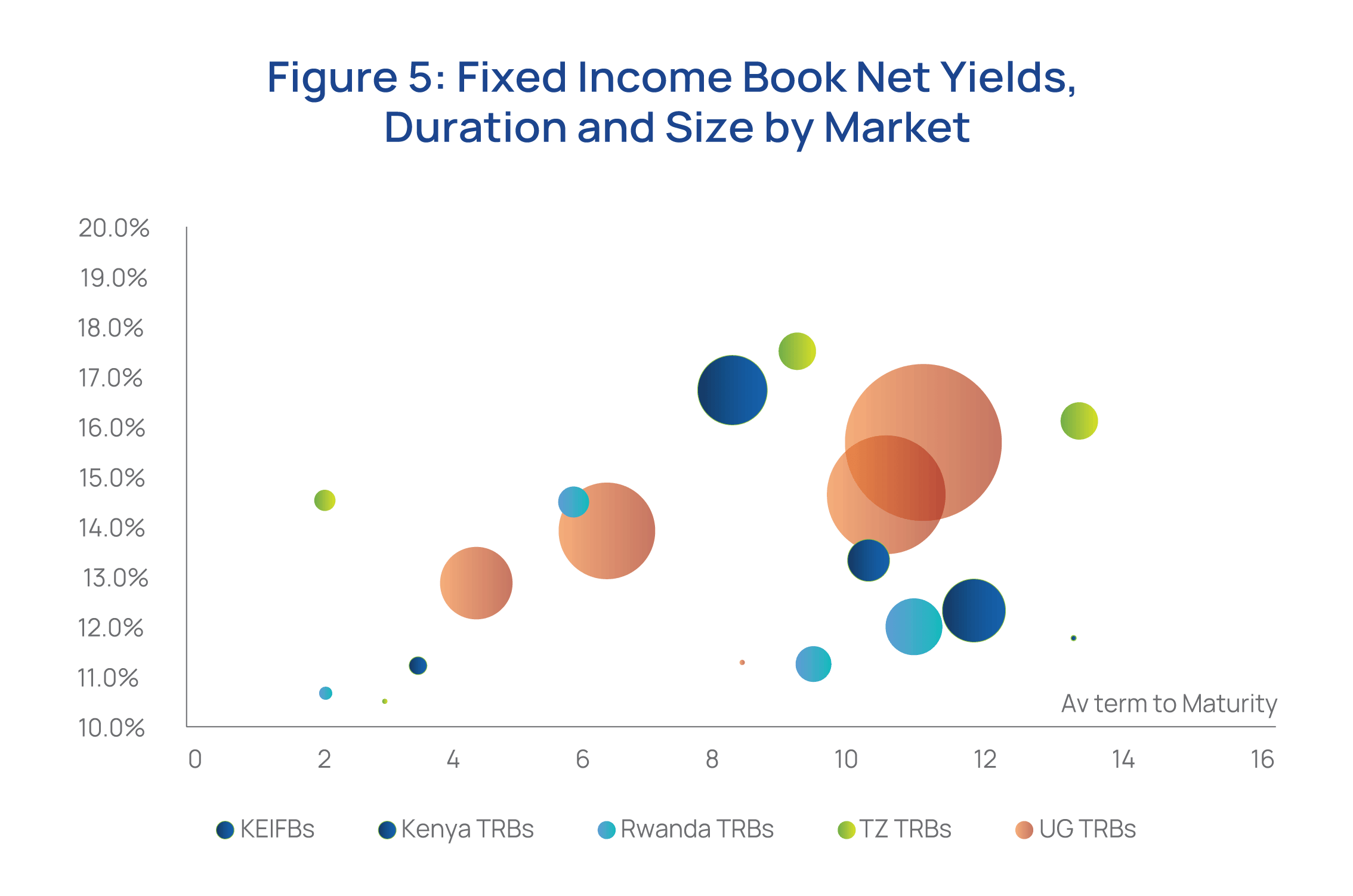
The fixed income portfolio closed the year at UGX 24.7 trillion, from UGX 20.5 trillion a year earlier. It generated interest income of approximately UGX 3.50 trillion, from UGX 2.88 trillion, translating into a return of 16.0% over the twelve months. The book remained dominated by medium- to longer-dated government securities, consistent with the long-term profile of the Fund's obligations.
Allocation continued to tilt towards Uganda, which rose to 72.4% of the fixed income portfolio from 66.8% a year earlier. This was attributed to the direction of new flows to Ugandan treasury bonds, where yields remained the most attractive in the region. Regional holdings declined correspondingly, to 20.7% in Kenya and 6.8% in Tanzania, reflecting both the deliberate reallocation and the depreciation of the Kenyan and Tanzanian shillings against the Ugandan shilling over the year.
Looking ahead, the principal consideration is reinvestment risk. The government's lighter domestic financing requirement for FY2026/27 — a net of UGX 11.90 trillion, down from UGX 15.20 trillion — together with firm investor demand (both domestic and foreign), points to downward pressure on yields in the year ahead. The rates strategy is accordingly oriented towards locking in long-end yields which are at historically average or higher than average levels.
The country strategy is focused on Uganda, while closely watching a Kenyan market facing inflationary pressures in a pre-election year. The upside risk to inflation, its bearing on regional rates and subsequent currency impact remain the key macro factors to watch for the year ahead.