
Global economic indicators
3.0%
Global GDP growth
FY2025
4.7%
Global inflation
FY2026
Operating Context
04NSSF operates in a dynamic environment shaped by economic, technological, regional and organisational developments.

External Environment
Global economic indicators
Global GDP growth
FY2025
Global inflation
FY2026
The global economy entered FY2025/26 on a tailwind of stabilisation. The IMF's July 2025 World Economic Outlook projected global GDP growth at 3.0% for 2025 and 3.1% for 2026, supported by stronger-than-expected economic activity, easing trade tensions and fiscal stimulus in major economies. Global inflation continued to moderate, while central banks in the United States and United Kingdom began lowering interest rates.
The operating environment changed significantly following the escalation of the Israel-Iran-US conflict in June 2025. The conflict disrupted global energy markets, with renewed hostilities in early 2026 affecting shipping through the Strait of Hormuz, a critical global oil transit route. Brent crude oil rose above USD100 per barrel before easing following a ceasefire in June 2026, although energy markets remained volatile and shipping costs elevated.
Reflecting these developments, the IMF's July 2026 World Economic Outlook revised global inflation upward to 4.7% for 2026 driven largely by higher energy prices, while maintaining global growth at 3.0%. The IMF noted that geopolitical conflict and technological transformation continued to shape an increasingly uncertain global economic environment.
Higher global energy prices contributed to increased fuel costs, inflationary pressures, and exchange rate volatility in Uganda. According to the Bank of Uganda, the Uganda shilling depreciated by approximately 5.4% between February and April 2026, largely reflecting higher global oil prices. As a significant consumer of fuel across its operations and facilities, the Fund experienced increased operating costs during this period.
The Fund continues to monitor global economic developments and geopolitical risks, particularly where they may affect investment markets across East Africa. While foreign exchange volatility did not materially impact the Fund's investment portfolio, management maintained disciplined cost controls to mitigate rising operational expenses and ensure business continuity while preserving financial resilience.
Regional overview
East Africa's economies entered FY2025/26 from positions of relative macroeconomic stability, demonstrating resilient growth and contained inflation despite an uncertain global environment.
While economic performance varied across markets, the region remained exposed to rising fuel import costs as geopolitical tensions in the Middle East intensified toward the end of the financial year. As net importers of petroleum products, the Fund's investment markets experienced higher fuel prices and inflationary pressures, with the timing and extent of these impacts influenced by each country's fuel procurement framework.
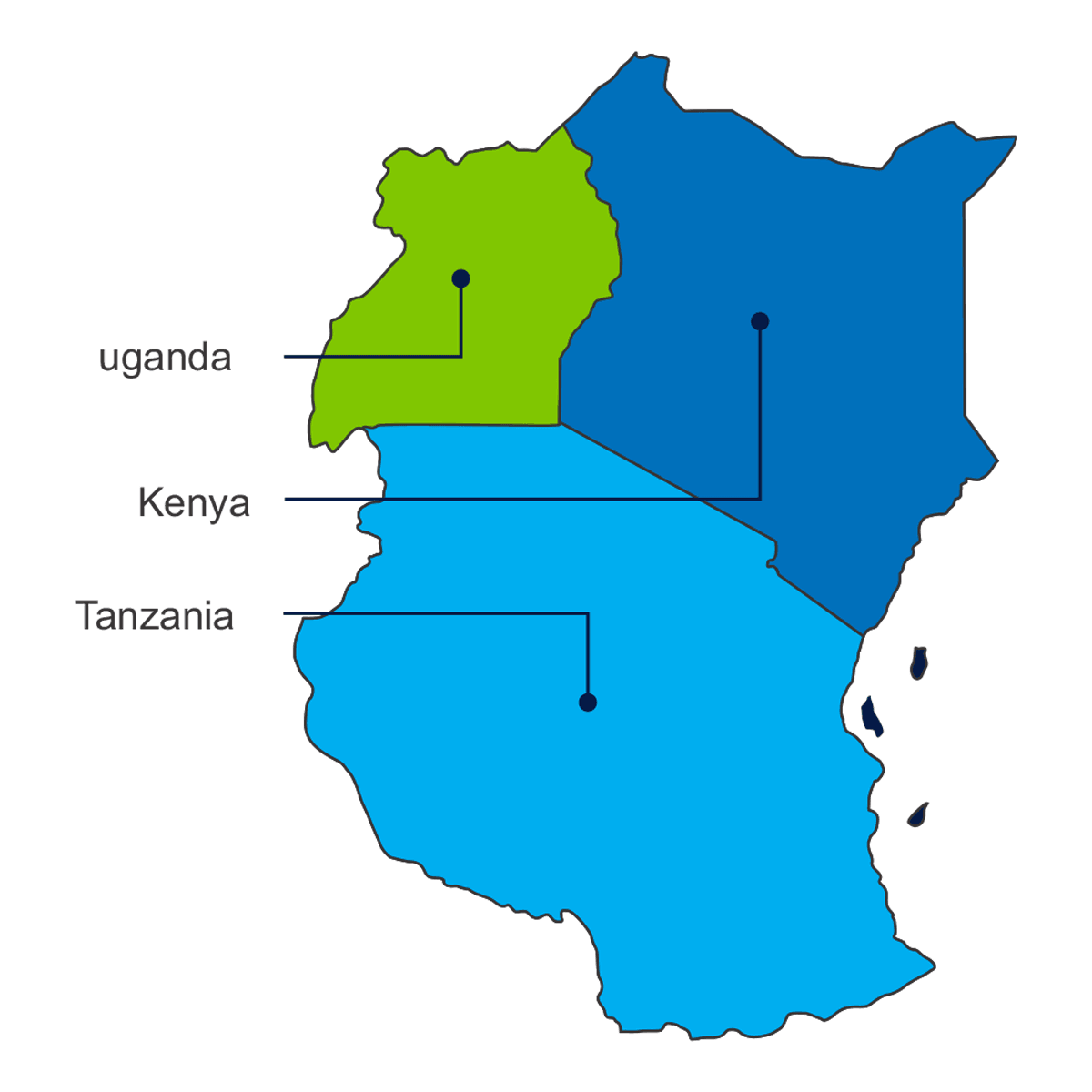
Resilient growth, contained inflation, and improving fundamentals across key markets provide a supportive environment for long-term investment and regional integration.
GDP growth FY2025
GDP growth FY2025
GDP growth FY2025
Regional overview: East Africa

Kenya's economy grew by an estimated 5.0% in 2025, up from 4.7% in 2024 according to the African Development Bank, driven by a recovery in industrial and services activity and an easing monetary policy stance. The Central Bank of Kenya continued its easing cycle, reducing the benchmark rate to 8.75% by February 2026, while inflation remained contained at 4.1%, within the target range.
Fiscal sustainability remained Kenya's principal macroeconomic vulnerability. The FY2025/26 fiscal deficit widened to 6.7% of GDP, exceeding the government's target of 4.7%, largely due to revenue shortfalls. Public debt remained elevated at 68.8% of GDP, with the IMF projecting a further increase to 71.6% by end of 2026 as persistent fiscal deficits continue to constrain fiscal flexibility. The World Bank noted that Kenya is at a pivotal moment, with current policy choices likely to determine the quality and durability of future growth.
Against the backdrop of political and fiscal uncertainty in recent years, including the 2024 tax protests and withdrawal of the Finance Bill, FY2025/26 marked a period of greater macroeconomic and political stability for Kenya.
Kenya's lower interest rate environment increased the relative attractiveness of higher-yielding regional fixed-income markets, including Uganda. At the same time, the robust performance of the Nairobi Securities Exchange enhanced the value of the Fund's listed equity portfolio. The Fund benefited from rising equity price gains while maintaining a disciplined, long-term investment approach.
The Fund continues to actively monitor economic conditions across its regional investment markets and allocate capital to opportunities that offer the best long-term risk-adjusted returns within its mandate. The improving outlook for Kenya supported the Fund's decision to maintain its strategic holdings while selectively increasing exposure to attractively valued counters.
Regional overview: East Africa

Tanzania’s economy remained one of the strongest performers in the region, with real GDP accelerating to 6.0% in 2025, from 5.5% in 2024, driven by agriculture, mining, and construction. Inflation remained contained, averaging 3.3%, allowing the Bank of Tanzania to reduce its Central Bank Rate to 5.75%.
External sector performance also strengthened, supported by record gold export earnings of USD 4.7 billion, while foreign exchange reserves increased to 4.9 months of import cover.
Fiscal discipline remained a key strength. The fiscal deficit widened modestly 3.4% of GDP, while public debt remained sustainable at an estimated 49.6% of GDP, below the IMF's sustainability threshold. Tanzania's medium-term outlook continues to be supported by strategic infrastructure investments, including the East African Crude Oil Pipeline (EACOP) and preparations for the AFCON 2027 tournament. Although higher global fuel prices are expected to increase inflationary pressures, inflation is projected to remain within the Bank of Tanzania's target range.
Tanzania's resilient economic performance and prudent fiscal management supported favourable operating conditions for the Fund's portfolio companies. Robust performance across selected holdings, together with share price appreciation on certain counters, created opportunities for active portfolio management while reinforcing the Fund's long-term investment strategy.
The Fund continues to maintain a long-term investment perspective in Tanzania, regularly reviewing portfolio performance and market developments to identify opportunities that align with its strategic asset allocation objectives.
External Environment

Uganda's domestic economy remained resilient in FY2025/26. Real GDP grew by 6.3% in FY2024/25, with growth projected at 6.5%–7.0% for FY2025/26. Inflation remained well contained through most of the year, averaging around 3.1%–3.2% and remaining below the Bank of Uganda's 5% medium-term target, supported by exchange rate stability, favourable food supply conditions, and lower global energy prices. The escalation of the Middle East conflict during the final quarter of the financial year increased global fuel prices, contributing to inflationary pressures and a temporary depreciation of the Uganda shilling.
Despite this, the Bank of Uganda maintained the Central Bank Rate at 9.75% through the year, while the country's external position remained strong.
Foreign exchange reserves increased to USD 6.01 billion (4.0 months of import cover) by the end of March 2026, supported by commodity exports, foreign exchange purchases, and oil-sector investment inflows.
Yields on Government securities remained attractive relative to regional peers, reflecting increased domestic borrowing ahead of the January 2026 general election before moderating thereafter.
The continued progress of the East African Crude Oil Pipeline (EACOP), which reached 82% completion by April 2026, reinforced expectations of stronger medium-term economic growth.
Uganda's resilient macroeconomic environment supported the Fund's investment performance and core operational objectives.
Attractive domestic fixed-income yields enhanced investment opportunities, while continued economic growth and formal sector expansion supported contribution growth and broader social security coverage.
The Fund continues to monitor domestic economic developments and implemented targeted strategies to optimise investment performance, strengthen collections, and expand social security coverage. These include broadening member and employer participation, promoting voluntary savings and advancing initiatives that deepen financial inclusion while safeguarding and growing member value.
NSSF Integrated Report 2026
Start typing to search the Integrated Report.
Download the full report, complete chapters or selected report sections.
No sections selected